
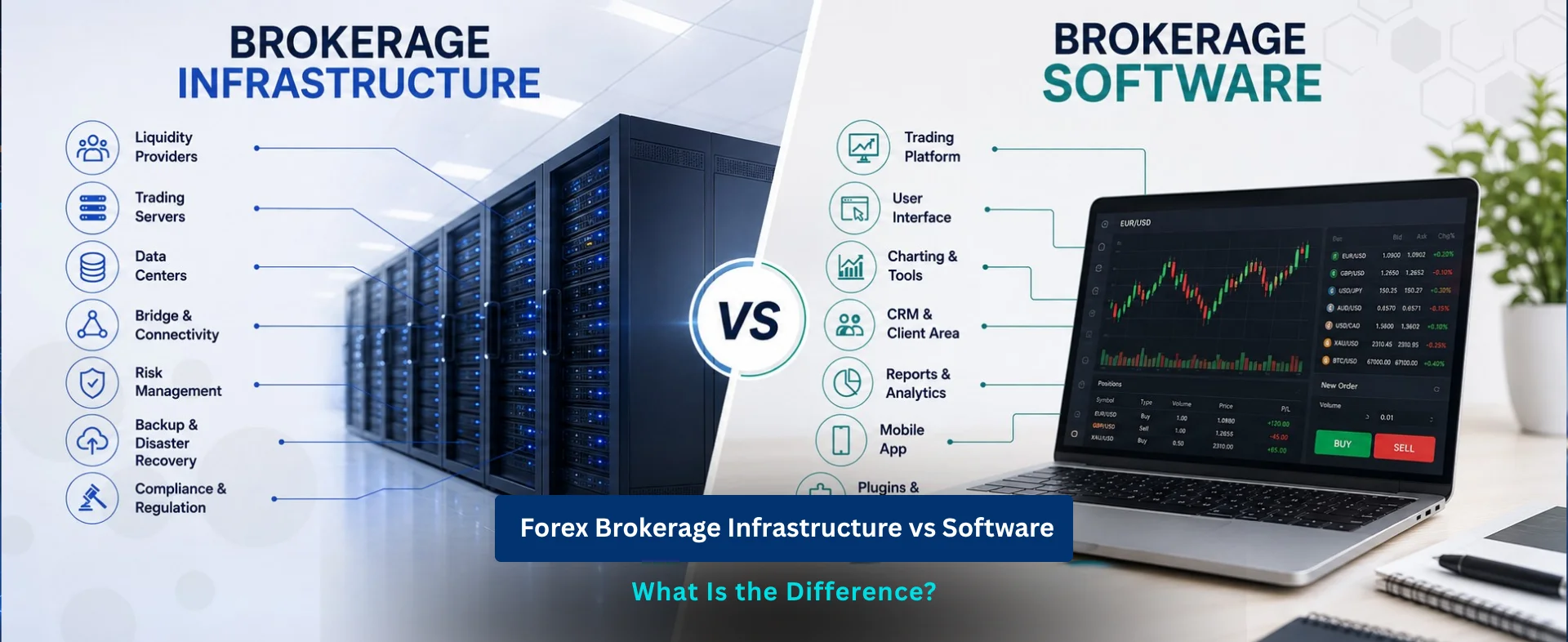
Forex Brokerage Infrastructure vs Software: What Is the Difference?
When people talk about starting a forex brokerage, two terms often get mixed up: forex brokerage software and forex brokerage infrastructure.
They sound similar, but they are not exactly the same.
Software usually refers to the applications and tools that help a broker run specific parts of the business. Infrastructure is the wider technical foundation that connects those tools and keeps the brokerage running.
A modern brokerage may use a trading platform, CRM, liquidity bridge, risk management system, payment tools, KYC solutions, client portal, APIs, servers, databases, and reporting systems. The important part is how these pieces work together.
Understanding this difference can help brokers make better technology decisions and avoid building a system that becomes difficult to manage as the business grows.
What Is Forex Brokerage Software?
Forex brokerage software is the collection of applications used to manage different brokerage activities.
Examples include:
- Trading platforms such as MT4 and MT5
- Forex CRM
- Client portal or Trader’s Room
- KYC and AML software
- Risk management tools
- Payment systems
- IB and affiliate management
- Reporting tools
- Communication and automation tools
Each software product normally performs a specific job.
For example, a CRM can manage leads and clients, while a trading platform allows clients to place trades.
So, software is about what the brokerage uses to perform tasks.
Modern forex brokerage software is increasingly designed as a connected stack rather than a single standalone application.

What Is Forex Brokerage Infrastructure?
Forex brokerage infrastructure is the broader technical foundation behind the brokerage.
It includes the software, servers, connectivity, databases, APIs, liquidity connections, security systems, and other technical components required to keep the business operating.
A simple way to understand it is:
Software = the tools
Infrastructure = the environment and connections that make the tools work together
For example, a trader may see an MT5 trading terminal.
Behind that terminal can be:
Trader → MT5 → Broker Server → Bridge → Liquidity Provider → Execution
At the same time, other systems may connect with the CRM, payments, KYC, reporting, and risk management layers.
That entire connected environment is part of the brokerage infrastructure.

The Simple Difference Between Software and Infrastructure
Think about a car.
The software is like the dashboard and controls that help you use the car.
The infrastructure is everything underneath that makes the car operate: engine, electrical system, fuel system, transmission, connections, and other components.
A forex brokerage works in a similar way.
| Forex Brokerage Software | Forex Brokerage Infrastructure |
| Trading platform | Trading servers |
| CRM | APIs and integrations |
| KYC software | Data and connectivity layer |
| Payment software | Payment infrastructure |
| Risk software | Execution and routing infrastructure |
| Client portal | Hosting and security |
| Reporting software | Databases and data services |
The two work together.
Good software running on weak infrastructure can still create problems.

Why the Trading Platform Is Only One Part
Many new brokers start with one question:
“Which trading platform should we choose?”
The trading platform is important, but it is only one layer.
MT4 or MT5 may provide the trading environment, but the broker still needs supporting systems for:
- Liquidity
- Order routing
- Risk management
- Client management
- Payments
- Compliance
- Reporting
- Back-office operations
Modern infrastructure guides specifically describe the trading platform as one component of a much larger brokerage technology stack.
This is why choosing MT5 alone does not mean a broker has built its complete technology infrastructure.

What Does Forex Brokerage Software Usually Include?
Trading Platform
This is where clients view markets and place orders.
Common examples include MT4, MT5, cTrader, and other trading platforms.
Forex CRM
The CRM manages the client journey, from lead acquisition and registration to onboarding, communication, and retention.
A purpose-built forex CRM can also connect with trading accounts, KYC, payments, and IB management.
KYC and AML Tools
These tools support client verification and compliance workflows.
Payment Systems
Payment software helps manage deposits, withdrawals, transaction statuses, and related workflows.
Risk Management
Risk tools help brokers monitor exposure, positions, margin, trading activity, and other important risk factors.
Reporting and Analytics
Reporting tools help management understand client activity, revenue, trading volume, payments, and business performance.
These are examples of software components.

What Does Brokerage Infrastructure Usually Include?
Infrastructure goes deeper.
It can include:
Trading Servers
Servers process trading activity and maintain account information.
Liquidity Connectivity
Bridges, gateways, aggregators, and APIs can connect the broker’s trading environment with liquidity providers.
Hosting and Data Centres
Where systems are hosted can affect availability, performance, latency, and resilience.
Not every part of a brokerage needs the same hosting setup. Trading systems may have different latency requirements from websites, reporting tools, or CRM systems.
Databases and Data Services
These systems store and process information needed for reporting, risk, client management, and integrations.
APIs
APIs allow different software systems to exchange information.
For example:
MT5 ↔ CRM
CRM ↔ KYC
CRM ↔ Payments
Trading ↔ Risk
CRM ↔ Reporting
Security
Infrastructure also includes authentication, access control, encryption, monitoring, backups, and other security measures.

Why Integration Matters More Than the Number of Tools
A broker can have excellent software but still have a poor technology setup.
Why?
Because the systems may not communicate properly.
Imagine a client completes registration.
The CRM records the client.
But the KYC system does not update the CRM.
Then the payment system does not update the client account.
Finally, the trading account has to be activated manually.
The broker now has several separate systems and a lot of manual work.
This is one of the biggest problems with fragmented brokerage technology. Current infrastructure analysis highlights the handoffs between CRM, trading, payments, liquidity, and risk as major operational pressure points.
The goal should not be:
“How many tools do we have?”
It should be:
“How well do our systems work together?”

Software Can Be Replaced. Infrastructure Needs More Planning.
A broker may replace its CRM.
It may change its payment provider.
It may add another liquidity provider.
It may upgrade its client portal.
But these changes can become difficult if the entire technology environment was built without proper integration planning.
A scalable infrastructure should allow individual components to be upgraded without breaking the entire brokerage.
This is one reason APIs and modular architecture are becoming important in modern brokerage technology.

Infrastructure Helps a Brokerage Scale
A system that works for 500 clients may not work as smoothly for 50,000.
As the business grows, the brokerage handles more:
- Trading accounts
- Orders
- Client records
- Payments
- KYC documents
- API requests
- Reports
- Support requests
- Partner activity
Infrastructure needs to handle this growth.
Scalability is therefore not just about buying more software. It is about making sure servers, databases, integrations, liquidity connections, and operational systems can support increasing demand.

Which One Should a Broker Choose First?
The answer is: neither should be treated separately.
A broker should first define the overall business and technology architecture.
Then it can decide which software components are needed.
For example:
Business Model
↓
Required Asset Classes
↓
Trading Platform
↓
Liquidity & Execution
↓
CRM & Back Office
↓
KYC & Compliance
↓
Payments
↓
Risk Management
↓
Client Portal
↓
APIs & Data
↓
Reporting & Security
This approach helps prevent the common mistake of buying software first and trying to connect everything later.

Common Mistakes Brokers Should Avoid
Choosing Software Based Only on Features
A long feature list does not guarantee that the system will work well for your brokerage.
Ignoring Integration
A CRM that cannot communicate properly with your trading platform or payment systems can create unnecessary manual work.
Focusing Only on the Front End
A beautiful client portal does not solve problems with liquidity, risk, servers, or back-office operations.
Building Without Scalability
Technology should be designed for future growth, not only the number of clients you have today.
Using Too Many Unconnected Vendors
Every additional vendor can introduce another contract, integration, support process, and potential point of failure.

How SetupFX Can Help
SetupFX helps brokers bring different parts of their brokerage technology environment together.
Solutions can include:
- MT4 and MT5 integration
- Forex CRM
- Liquidity and bridge solutions
- Payment integration
- KYC and AML workflows
- Client portals
- IB and affiliate management
- Risk management technology
- APIs and system integrations
- Reporting and analytics
- Back-office solutions
- Automation
The objective is not simply to give brokers more software.
It is to help create a connected brokerage technology environment that can support daily operations and future growth.
Final Thoughts
Forex brokerage software and infrastructure are closely connected, but they are not the same thing.
Software gives a broker the tools it needs.
Infrastructure provides the foundation that connects and supports those tools.
A trading platform, CRM, payment system, KYC solution, and risk tool can each be useful on their own.
But their real value comes when they work together.
For a growing brokerage, the right question is therefore not:
“Which software should we buy?”
It is:
“What technology infrastructure do we need, and which software will fit into it?”
That small change in thinking can help brokers build a system that is easier to operate, easier to scale, and better prepared for future growth.
1. What is the difference between forex brokerage software and infrastructure?
2. Is MT5 forex brokerage software or infrastructure?
3. Does a forex broker need both software and infrastructure?
4. Why are APIs important for forex broker infrastructure?
5. Can a forex broker use different software providers?
6. What should brokers consider when building infrastructure?